
Using AI To Diagnose Agile Team Problems Faster | Agile Coaches & Delivery Leads
One of the most common mistakes I see Agile Coaches, Scrum Masters and Delivery Leads make is trying to solve the wrong problem.
"Our retrospectives don't work."
What they usually mean is:
The same issues come up every Sprint
Nobody wants to speak openly
Conflict feels uncomfortable
Actions never get completed
People have stopped believing anything will change
People have stopped attending
Retrospectives aren't the problem.
They're simply where the symptoms are showing up.
Reflecting on this I explored how AI could support Agile Coaches, Scrum Masters, Project Managers and Delivery Leads in diagnosing team challenges more efficiently.
The following example is based on common patterns I've observed while working with Technology Leaders, Enterprise Coaches and Delivery teams, transitioning from Waterfall to Agile.
My focus was on using AI as a thinking partner and an analysis tool.
How I Would Use AI In This Situation
Imagine a team six months into an Agile transition. Retrospectives are becoming increasingly difficult. Participation is dropping and the same issues continue to surface. Here's how I would use AI to accelerate diagnosis while still relying on coaching expertise to determine the right intervention.
The symptoms might include:
Low engagement
Difficult retrospectives
Escalating frustration
Repeated Sprint issues
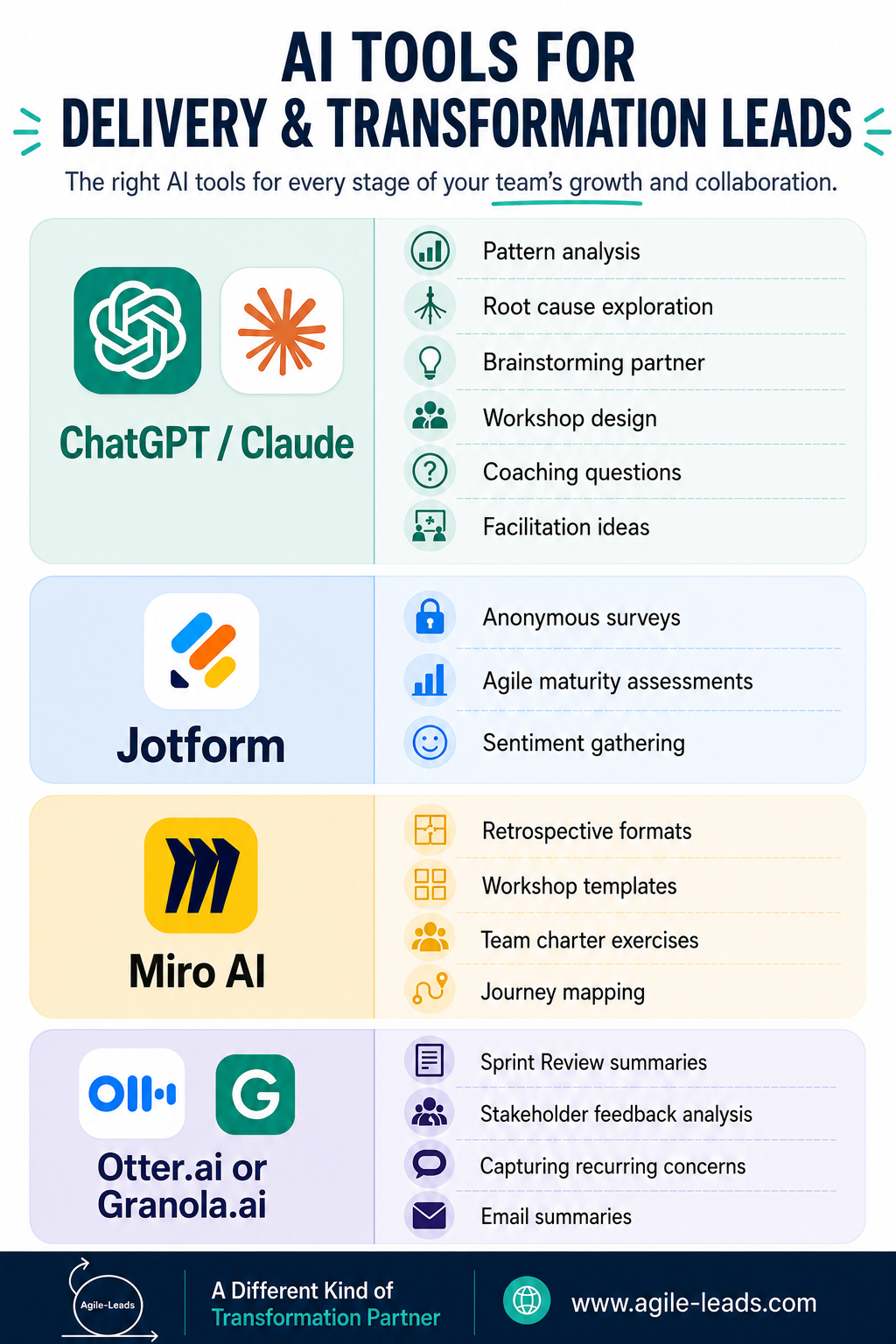
AI TOOLS FOR DELIVERY & TRANSFORMATION LEADS
Step 1: Gather Evidence
Agile maturity assessment
Sprint observations
Stakeholder feedback
Team interviews
Tool Options:
ChatGPT TO generate questions for Agile Maturity Assessment.
Jotform to create an anonymous survey and visualise results.
Step 2: Use AI To Analyse Themes
Once the data has come back I’d personally use ChatGPT for speedy analysis.
Example prompts to give ChatGTP:
Review these anonymised assessment results and identify recurring themes.
What patterns suggest low psychological safety?
What coaching interventions might address these issues?
What questions should I explore further before deciding on interventions?
What assumptions might I be making based on this data?
Step 3: Explore Intervention Options
In a scenario like this, the root cause could be any number of things. However, based on my experience coaching teams through Agile transitions, I often see recurring themes such as:
TASK CONFLICT
Unclear roles and responsibilities creating confusion, duplication of effort or tension within the team.
LACK OF TIME
Teams consistently planning more work than they can realistically deliver, leading to frustration and a constant feeling of being behind.
LACK OF AUTONOMY
Teams feeling unable to make decisions, challenge priorities or influence how they work, resulting in reduced engagement and ownership.
It's also common to see teams developing their Agile capability while key individuals are simultaneously learning new responsibilities as Product Owners or Scrum Masters. In many cases, leaders are also navigating how best to support teams through this transition.
Once potential themes have been identified, experienced Agile Coaches, Scrum Masters and Delivery Leads would typically draw on a range of approaches, including:
Team workshops
Coaching sessions
Facilitation techniques
Leadership conversations
Role clarity exercises
Working agreements
Step 4: Practical Assets
This is where AI can become a useful thinking partner.
Using tools such as ChatGPT or Claude to explore potential interventions can help generate ideas, challenge assumptions and accelerate preparation. For example, AI might suggest:
Alternative retrospective formats
Team charter exercises
Working agreement templates
Psychological safety workshops
Team Dynamics workshops
Coaching questions for leaders
Agile leadership advisory topics
Similarly, tools such as Miro can provide retrospective and workshop templates, particularly useful for teams that are new to Agile or experiencing conflict.
The important distinction is that AI can generate options.
Experience determines which options are most appropriate for the team, culture and organisational context.
AI generates options. Experience determines outcomes.
Step 5: Diagnose The Real Problem
Retrospectives are rarely the root cause.
Common root causes:
Lack of trust
Unclear roles
Leadership behaviour
Fear of conflict
Lack of accountability
Final Thought
AI can help analyse faster.
It cannot understand organisational politics.
It cannot build trust.
It cannot coach a difficult conversation.
It cannot create psychological safety.
That's still our job.
A Little Disclaimer:
Whilst Chat GPT and other AI tools are amazing resources, they cannot replace experience or the passions and inspirations which fuel our professional lives. Any data and trends I have included have been substantiated via the sources I provide. The insights given in this article are based on my +23 years professional experience, my +11 years in senior leadership roles in The UAE and UK, and my own wide-ranging research. If this article has resonated with you please feel free to comment and share, feedback is always welcome and appreciated.