
Most organisations don't need less governance.
They need better governance.
Over the past decade, I've heard executives say:
"We're trying to be Agile, but we can't see results."
"Every project seems to be using a different methodology."
At the same time, I've heard Agile Delivery Leads and Agile Coaches frustrated by spending more time producing reports and administration than enabling delivery.
These aren't Agile problems. They're governance problems.
Many organisations respond by removing governance in the name of agility. Others, who feel agile is working as it should be, add more approval gates, reports and documentation.
Both approaches usually slow delivery.
The answer isn't choosing between Agile and governance. It's redesigning governance so it works with modern delivery rather than against it.
I've worked with Agile Chapters, Delivery Centres of Excellence and traditional PMOs. A few years ago, I joined a client that had none of these. A global consultancy was leading a highly complex digital programme, but the governance model wasn't providing the visibility or coordination the organisation needed.
As Executive Delivery Director, I built an Agile PMO, assembled a team of Agile Delivery Leads, and introduced a governance approach capable of coordinating multiple suppliers, government stakeholders and technology partners, while giving executives real-time visibility across a rapidly evolving programme.
This article shares what worked, what didn't, and what an Agile PMO actually looks like in practice.
The Challenge
The client was the Museum of the Future, one of the UAE's most ambitious tourist destinations, delivered through a complex government initiative ahead of a fixed public launch.
I established and led an Agile PMO that enabled faster decision-making, stronger governance and better collaboration across internal teams and external partners.
The programme presented several challenges:
+30 vendors delivering different parts of the ecosystem
+40 workstreams
Executives needing clear visibility across the programme
Traditional governance struggled to keep pace
Weekly reports were outdated almost as soon as they were produced
Dependencies emerged faster than they could be documented
Risk registers became historical records rather than decision-making tools
The programme needed an operating model built for change and complexity.
The Misunderstanding About Agile PMOs
One of the biggest misconceptions is that Agile organisations don't need PMOs.
Some really don’t. But in reality, complex organisations often need them more than ever.
What changes is their purpose.
Traditional PMOs govern through control.
Agile PMOs govern through transparency.
Instead of measuring activity, they measure flow.
Instead of approving work, they enable better decisions.
What We Built
Rather than creating another reporting office, I designed an operational support function based on four core principles, brought to life by a team of Agile Delivery Leads.
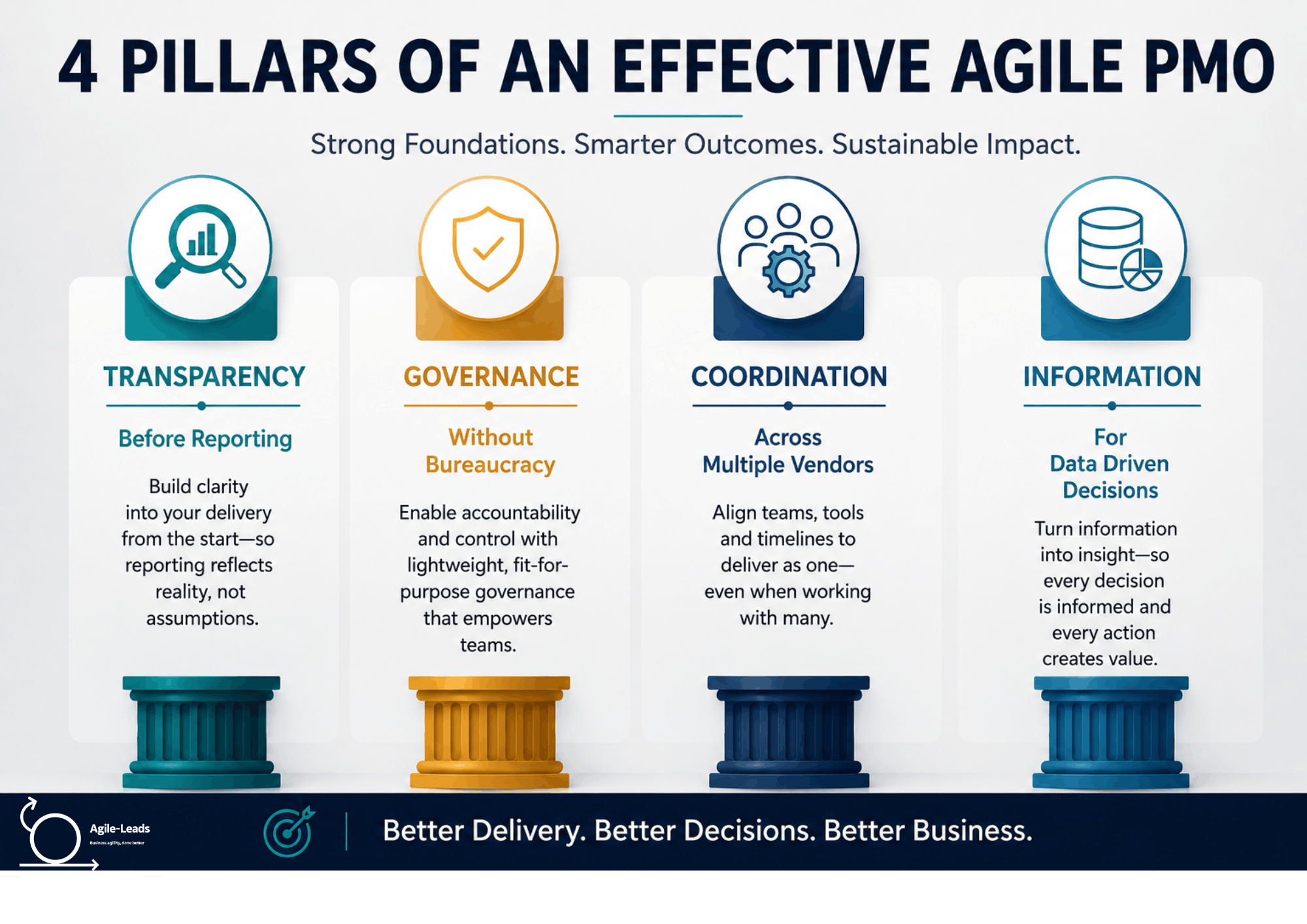
1. Transparency Before Reporting
Executives rarely need more reports, they need better visibility.
Instead of relying solely on weekly reports and Gantt charts, we created shared dashboards showing:
Delivery progress
Key dependencies
Programme risks
Supplier alignment
Upcoming milestones
Decision blockers
Some leaders preferred digital dashboards in Teamwork, while others wanted physical visual management boards in the executive office. Both presented the same live information.
2. Governance Without Bureaucracy
Governance often becomes synonymous with documentation.
Documentation alone rarely improves delivery.
We replaced heavy processes with lightweight governance centred on key decision points and real data.
Typical questions included:
Is this initiative still aligned with strategic outcomes?
Have delivery risks increased?
Are cross-team dependencies understood?
Does leadership need to intervene?
The result was faster governance with greater executive confidence.
3. Coordinating Multiple Vendors
Managing over 30 vendors was one of the programme's greatest challenges.
Each vendor had different planning approaches, reporting structures, delivery cadences and definitions of progress. Many were accustomed to traditional waterfall delivery.
Rather than acting as another management layer, the Agile PMO became the integration layer between organisations to align dependencies, improve communication and reduce hidden delivery risks.
4. Information That Drives Decisions
Many PMOs collect huge amounts of information. Very little influences decisions.
We deliberately simplified reporting and focused only on information executives repeatedly needed, including:
Which decisions are blocking delivery?
Where are dependencies increasing?
Which workstreams are most at risk?
Where is executive intervention required?
If information wasn't helping someone make a decision, we questioned why we were collecting it.
The Human Side of Governance
Technology alone doesn't improve governance. People do.
Rather than filling calendars with lengthy meetings, our Agile Delivery Leads spent time with teams, facilitated conversations and resolved issues before they escalated.
Daily stand-ups remained short and focused rather than becoming executive status meetings.
Our role was to:
Help leaders prioritise competing demands
Surface risks early
Facilitate cross-functional decisions
Build trust between vendors
Align expectations across the programme
Good governance is ultimately about enabling better conversations.
What I Learned
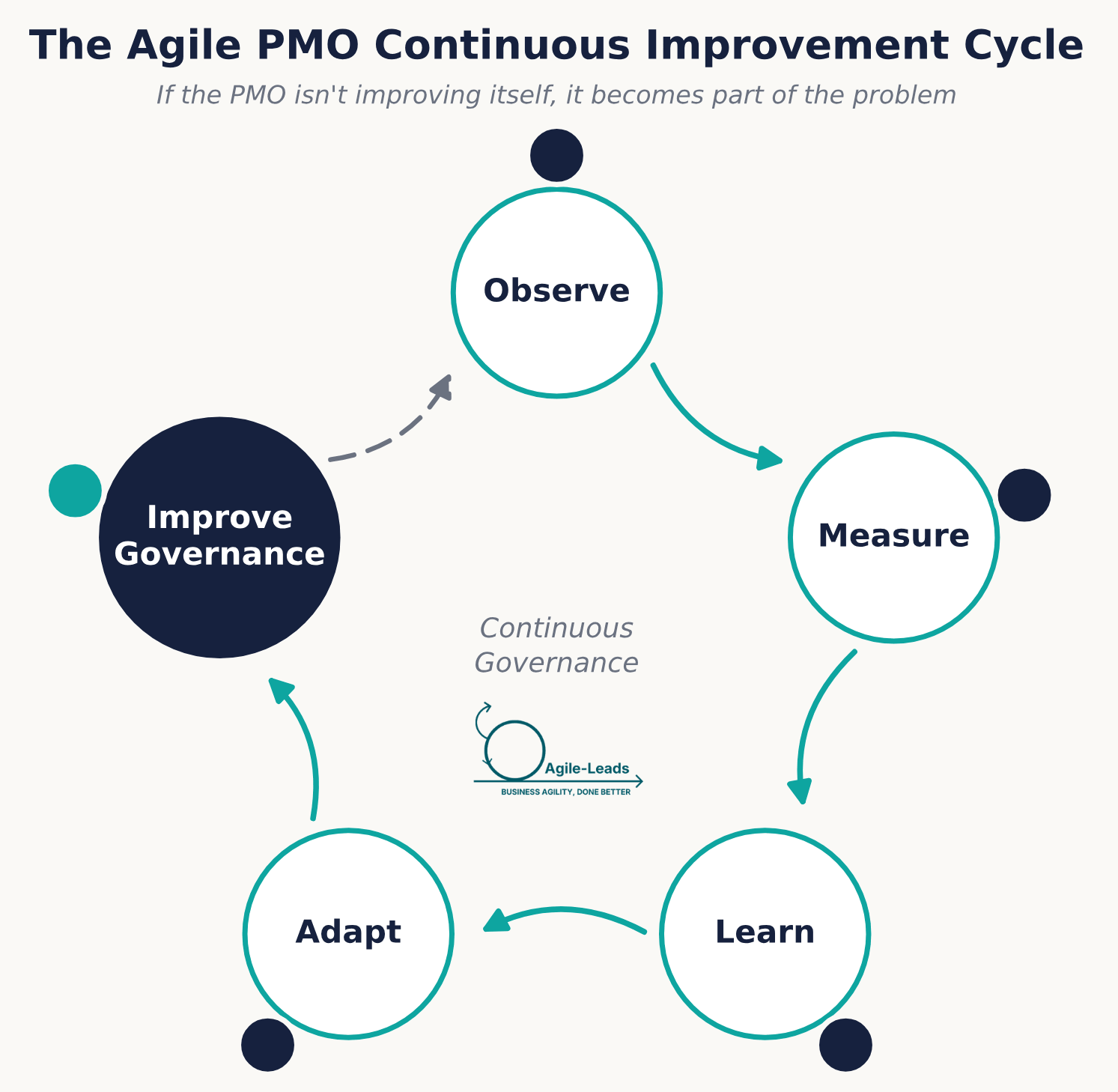
The Agile PMO CI Cycle
If the PMO isn’t evolving, it becomes part of the problem.
Several lessons continue to shape my approach today:
Governance should reduce uncertainty.
Every governance activity should help someone make a better decision. If it doesn't, question its purpose.
Visibility matters more than documentation.
Organisations often compensate for poor visibility by producing more documents. Better visibility naturally reduces reporting overhead.
Reporting should prompt action.
The best dashboards don't answer every question. They show leaders where attention is needed.
PMOs should improve continuously.
Like delivery teams, governance functions should inspect and adapt. If the PMO isn't evolving, it eventually becomes part of the problem.
Why This Matters
Today's organisations operate in a very different environment.
AI is accelerating delivery.
Products evolve continuously.
Technology ecosystems are increasingly interconnected.
Yet many governance models still rely on:
Monthly reporting
Annual planning cycles
Heavy approval processes
Static governance frameworks
These approaches struggle when priorities change every week.
The organisations succeeding today aren't removing governance. They're redesigning it.
Beyond Project Management
One of the biggest lessons from this programme was that Agile PMO principles extend far beyond project delivery.
Today I apply the same thinking when helping banks strengthen governance, supporting transformation programmes, and designing and implementing organisational operating models.
The challenge is rarely a lack of effort.
It's that complex systems make it difficult for leaders to see where intervention will have the greatest impact.
What an Agile PMO Really Does
It creates clarity.
It improves transparency.
It strengthens collaboration.
It removes friction.
Most importantly, it gives leaders confidence without slowing delivery
Final Thoughts
The phrase "Agile PMO" still sparks debate.
Some argue the concepts are incompatible.
My experience suggests otherwise. I've seen what happens when governance evolves instead of disappearing..
Delivery becomes more predictable.
Leaders make better decisions.
Teams spend less time reporting and more time delivering value.
The goal was never to build a different PMO.
It was to build a governance capability that matched the pace and complexity of modern digital delivery.
Years later, I believe that's still one of the greatest opportunities for organisations undertaking transformation.