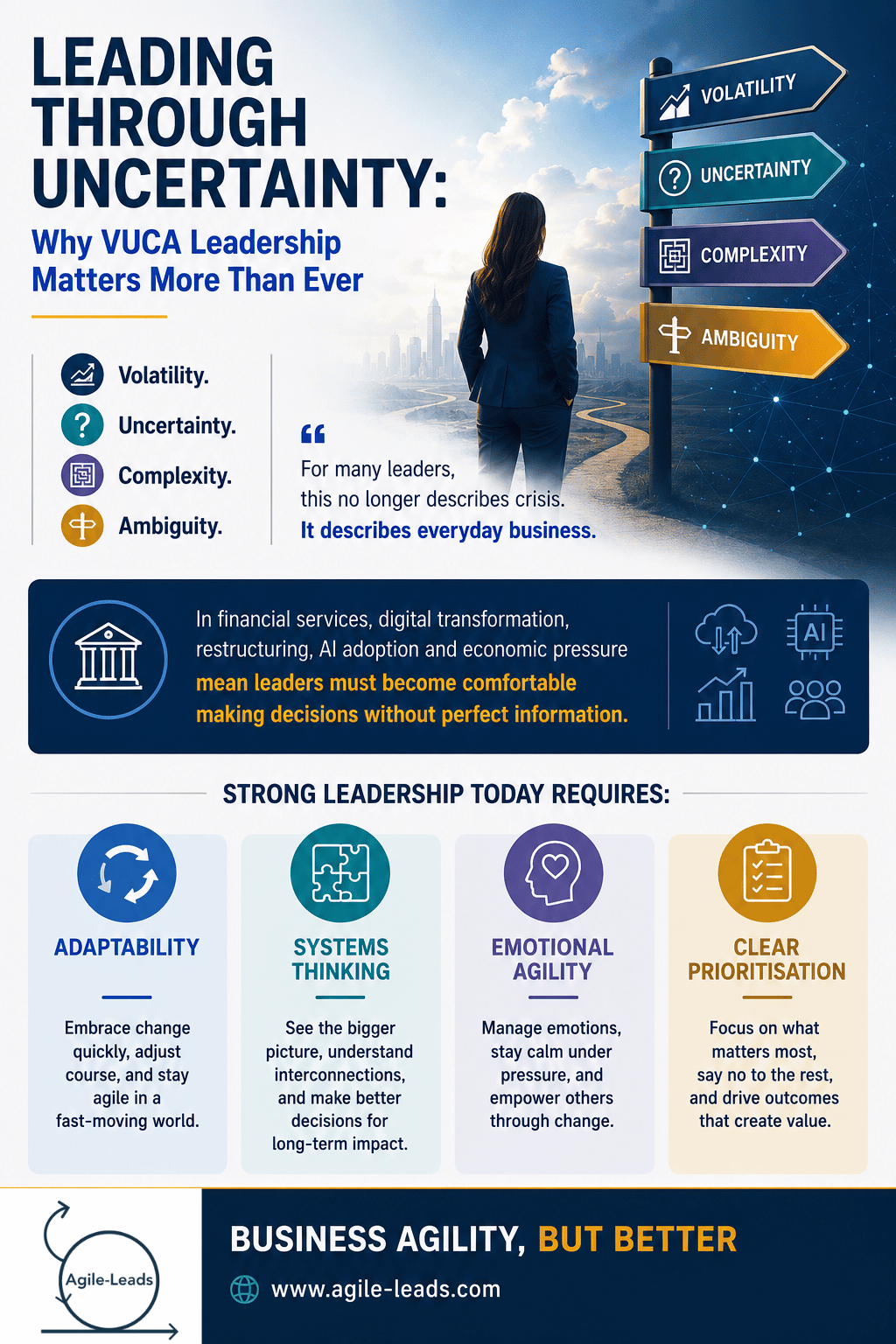
VUCA Isn’t New. But Your Leadership Model Might Be Outdated.
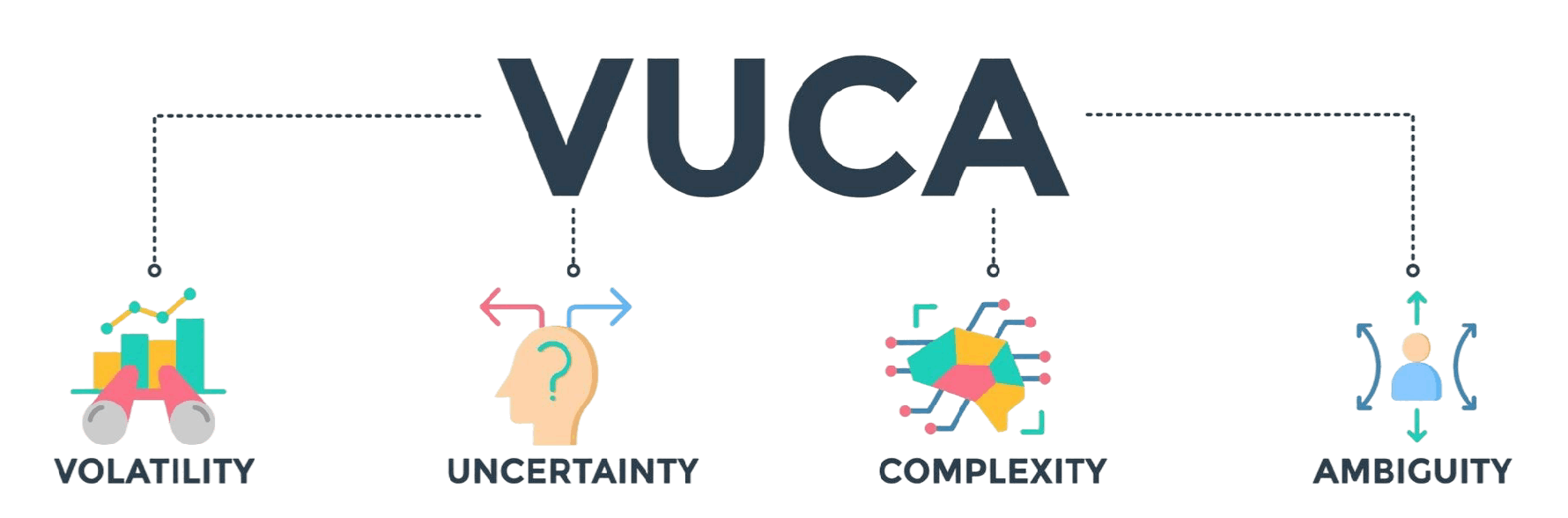
For years, we’ve described today’s environment with one word: VUCA.
Volatility – constant, often sudden change
Uncertainty – the future is unclear
Complexity – everything is interconnected
Ambiguity – no single “right” answer
VUCA
In large, complex organisations, such as banks, this isn’t theoretical.
It’s real.
Interest rates shift overnight
Regulations evolve faster than implementation cycles
Digital products span multiple teams, systems, and vendors
Customer behaviour is unpredictable
And yet, despite this reality…
Most leadership models are still built for a world of stability, predictability, and control
The Real Problem Isn’t VUCA
VUCA isn’t new.
What’s changed is the gap between the environment we operate in… and the way we lead within it.
Traditional leadership assumes:
Decisions can be made with complete information
Governance works best at the end of delivery
Planning creates certainty
Control reduces risk
But in a VUCA environment, these assumptions break down.
Decisions must be made with incomplete information
Risk must be managed continuously, not at the end
Plans must evolve as we learn
This is where many organisations struggle.
Not because they don’t understand change…
…but because their leadership model hasn’t caught up with it.
Why Traditional Leadership Struggles Under Pressure
When complexity increases, most organisations don’t become more adaptive.
They become more controlled.
You’ll recognise the patterns:
More approvals
More escalation
More reporting
More oversight
It feels safer.
But it creates the opposite effect:
❌ Slower decisions
❌ Delayed delivery
❌ Frustrated teams
❌ Hidden risks that surface too late
As highlighted in my recent work with banking clients, pressure doesn’t create agility - it exposes the limits of traditional leadership.
Harnessing agility is a leadership superpower, especially when working in highly regulated, complex industries such as banking.
The Shift: From Control to Enablement
The organisations that succeed in a VUCA world don’t eliminate governance or structure.
They evolve leadership behaviour. The shift is subtle, but powerful:
Traditional ⇒ Modern Leadership
Control ⇒ Enablement
Approval ⇒ Guardrails
Outputs ⇒ Outcomes
Silos ⇒ Flow
This is not about being “less structured.”
It’s about being structured differently.
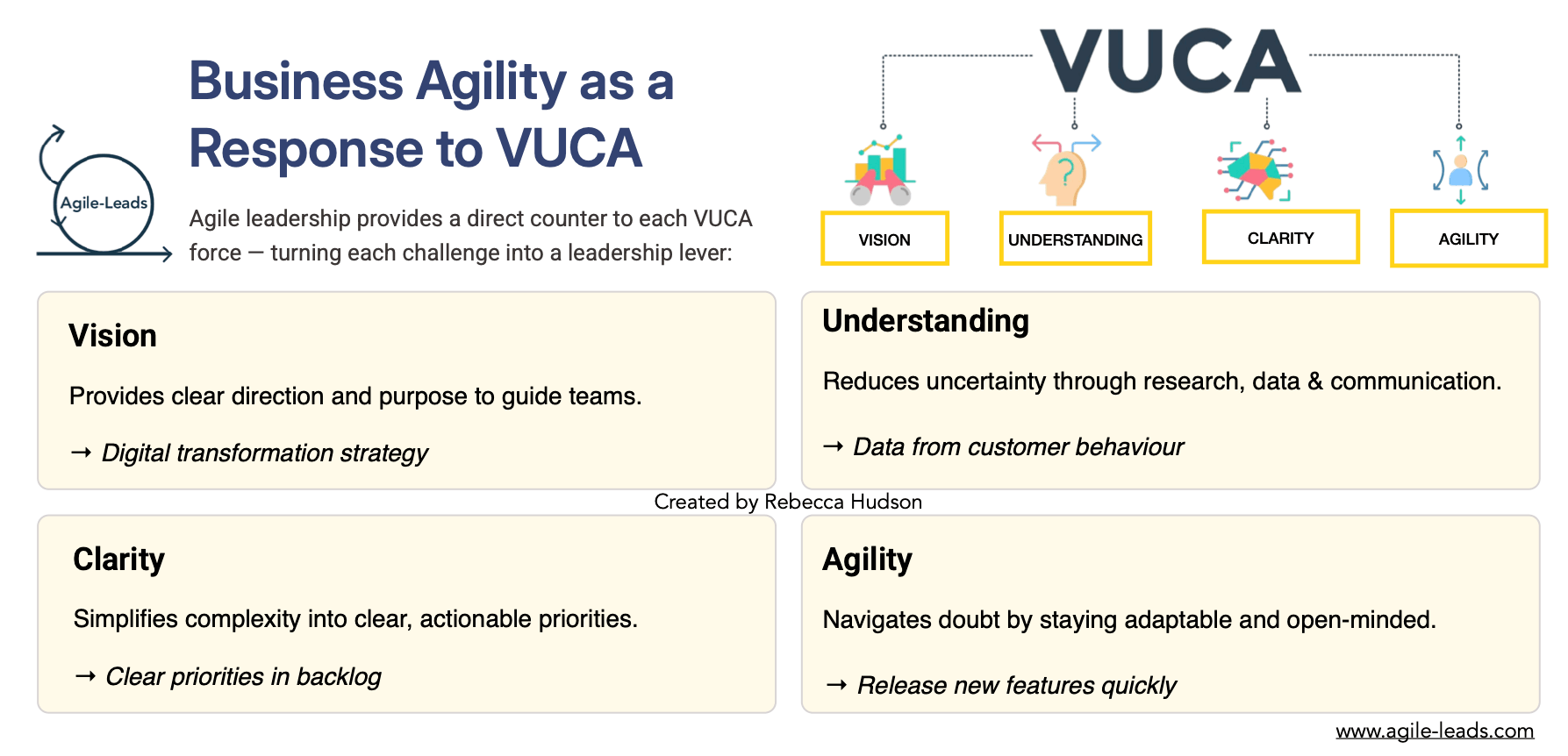
Business Agility = An Effective Response to VUCA
The most effective leaders I work with don’t try to eliminate VUCA.
They respond to it.
Business Agility as a Response to VUCA
Four capabilities stand out:
1. Vision → Countering Volatility
Clear direction creates stability in unstable environments.
Not detailed plans — but a strong “why” that guides decisions.
2. Understanding → Reducing Uncertainty
Leaders invest in:
Customer insight
Data
Feedback loops
Instead of waiting for certainty, they create it through learning.
3. Clarity → Managing Complexity
Complex systems don’t need more process.
They need:
Clear priorities
Clear ownership
Clear decision rights
Clarity accelerates flow.
4. Agility → Navigating Ambiguity
Ambiguity doesn’t disappear.
Leaders must:
Stay adaptable
Test ideas early
Change direction when needed
Progress over perfection
These four elements - Vision, Understanding, Clarity, Agility - form a practical leadership response to VUCA.
The Leadership Constraint
One of the most important realisations for senior leaders is this:
Leadership is now the constraint, or the enabler, of organisational performance.
Not strategy.
Not technology.
Not process.
Leadership.
Because:
Decisions get stuck where authority is unclear
Risk increases where transparency is delayed
Delivery slows where teams are not empowered
What This Means in Practice
You don’t need a full transformation to start shifting.
Small leadership changes have disproportionate impact:
Define decision boundaries clearly = What can teams decide without escalation?
Move governance earlier = Review continuously, not just at the end
Focus on value, not activity = What changed for the customer?
Remove one blocker per week = Consistent action compounds
These are simple shifts.
But they require a fundamental change in mindset:
From managing work…To enabling outcomes
Final Thought
The future won’t reward the fastest organisations.
It will reward the most adaptable.
And adaptability doesn’t come from frameworks or processes.
It comes from how leaders:
Think
Decide
Enable others
VUCA isn’t going away.
The question is:
Will your leadership evolve with it?