
Avoid the Unicorn Trap: Hire the Right People, Not Mythical Creatures
Rethinking the Future of Agile Coaching, Role Fluidity, and the Skills We Really Need
Originally published in 2025 | Updated September 2026
Editor's note: This article has been updated to reflect the evolving expectations placed on professionals, the growing influence of AI, and the importance of building diverse, adaptable teams.
Are We Expecting Too Much From Individuals?
During a leadership workshop for Lead Agile Coaches last year, we discussed the changing nature of Agile Coaching and the future of the profession. One question has stayed with me:
Are we developing versatile professionals, or simply expecting people to do more with less?
As organisations navigate digital transformation, AI adoption, economic pressures and shifting workforce expectations, traditional job boundaries are blurring. Agile Coaches are expected to understand organisational change and business strategy. Product Owners need commercial acumen and leadership skills. Delivery Leads must combine governance, coaching, data analytics and AI-enabled delivery, and these expectations extend well beyond Agile, across technology, HR, operations and transformation roles.
There's real value in broader skills. But when does versatility become unrealistic, and are we designing organisations around team capability, or searching for individuals who can do everything?
Agile Acumen Without the Job Title
One shift I've seen is that Agile capabilities now extend well beyond traditional Agile roles. Facilitation, systems thinking, collaboration and continuous improvement matter for Product Owners, Delivery Leads, People Partners and business leaders, not just Scrum Masters and Agile Coaches.
Across banking, financial services, government and enterprise technology, I've watched Agile Coaching responsibilities increasingly overlap with broader transformation and leadership roles. This doesn't make Agile Coaching irrelevant, it means these capabilities apply far beyond a single job title, giving those of us with Agile careers the chance to work across a broader range of business problems. The challenge is ensuring organisations understand the difference between transferable capabilities and expecting expertise in every discipline.
I've always believed in building teams who can wear multiple hats, as an Executive Delivery Director I hired people from diverse backgrounds who could adapt across clients and engagements. But this only works within limits.
Done well, people receive coaching and mentoring, and develop new capabilities gradually. Done poorly, they're placed into unfamiliar roles without support, expected to perform immediately, and left to navigate challenges beyond their experience, leading to stress and burnout for individuals, and poor outcomes and broken trust for organisations and clients.
Versatility is valuable. Unsupported versatility is a risk.
Comb-Shaped Skills or Just Unicorn Chasing?
We often talk about T-shaped professionals, Pi-shaped professionals and comb-shaped professionals.
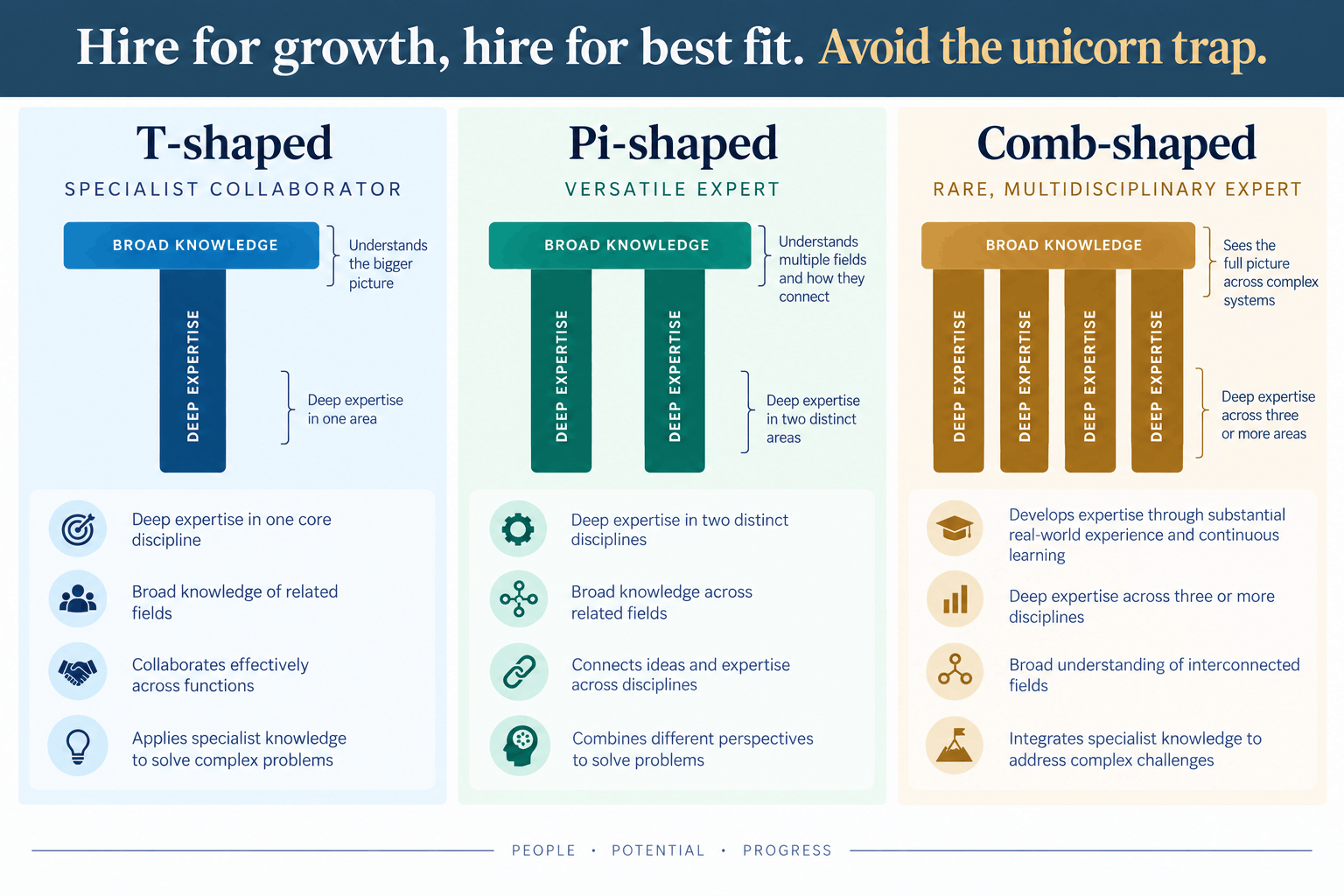
T-shaped, Pi-shaped and Comb-shaped people.
These models are useful for thinking about development and collaboration, but become problematic when treated as hiring requirements rather than development concepts.
I'm seeing job descriptions demanding expertise in Agile Coaching, product management, organisational change, portfolio governance, data analytics, AI enablement, stakeholder management and executive leadership, all at once. Each capability has value, but expecting deep expertise across all of them raises a real question:
Are we genuinely looking for adaptable professionals, or trying to replace an entire team with one person?
I've built multidisciplinary delivery teams where individuals successfully took on several responsibilities because we understood each person's strengths and limitations, and ensured the team had access to complementary expertise.
When organisations confuse skill diversity with unlimited individual capacity, they create roles that are hard to fill and harder to perform, and delivery quality suffers. Business agility should help organisations respond to complexity, not create more of it through unrealistic expectations.
When Skill Diversity Becomes a Shortcut
Skill diversification needs to be strategic, not reactive. Research from the Scrum Alliance and Business Agility Institute highlights growing demand for Agile-related capabilities, collaboration, communication and adaptability, beyond traditional Agile roles.
What were once dismissed as “soft skills” (coaching, facilitation, empathy, emotional intelligence, systems thinking) are now essential to how organisations operate, though this doesn't diminish functional expertise. And with AI, someone who can use the tools well won't necessarily have the judgement to validate what they produce.
Problems arise when organisations miss these distinctions. Common traps include:
Assuming skills transfer easily between unrelated disciplines
Overloading roles to cut headcount or cost
Prioritising technical expertise over human capabilities
Hiring for similarity rather than complementary strengths
Underestimating the depth needed in specialised domains
Skimping on learning, mentoring and development
Creating cultures where people can't admit what they don't know
The result isn't a more adaptable workforce, it's people struggling to meet expectations that were unrealistic from the start.
AI Is Adding Another Dimension to the Unicorn Trap
Since I first wrote this article, one question has become more relevant:
What happens when AI becomes another capability everyone is expected to possess?
AI offers real opportunities for Agile Coaches, Product Owners and Delivery Leads, it can support workshop preparation, requirements analysis, risk identification and more.
However, using AI well doesn't create expertise in the underlying discipline: someone can generate a product strategy without understanding product-market fit, or produce delivery metrics without understanding what they reveal about team performance.
AI can accelerate outputs, it can't guarantee the quality of thinking behind them.
Treated as a substitute for experience rather than a support to it, AI risks creating a new generation of unicorn job descriptions. Organisations need AI literacy, domain expertise, critical thinking and specialist capability to work together to create better outcomes.
Growth-Minded Teams
To build organisations that genuinely adapt, we need to stop designing roles around mythical individuals and instead build teams with complementary strengths, diverse experience and a shared willingness to learn.
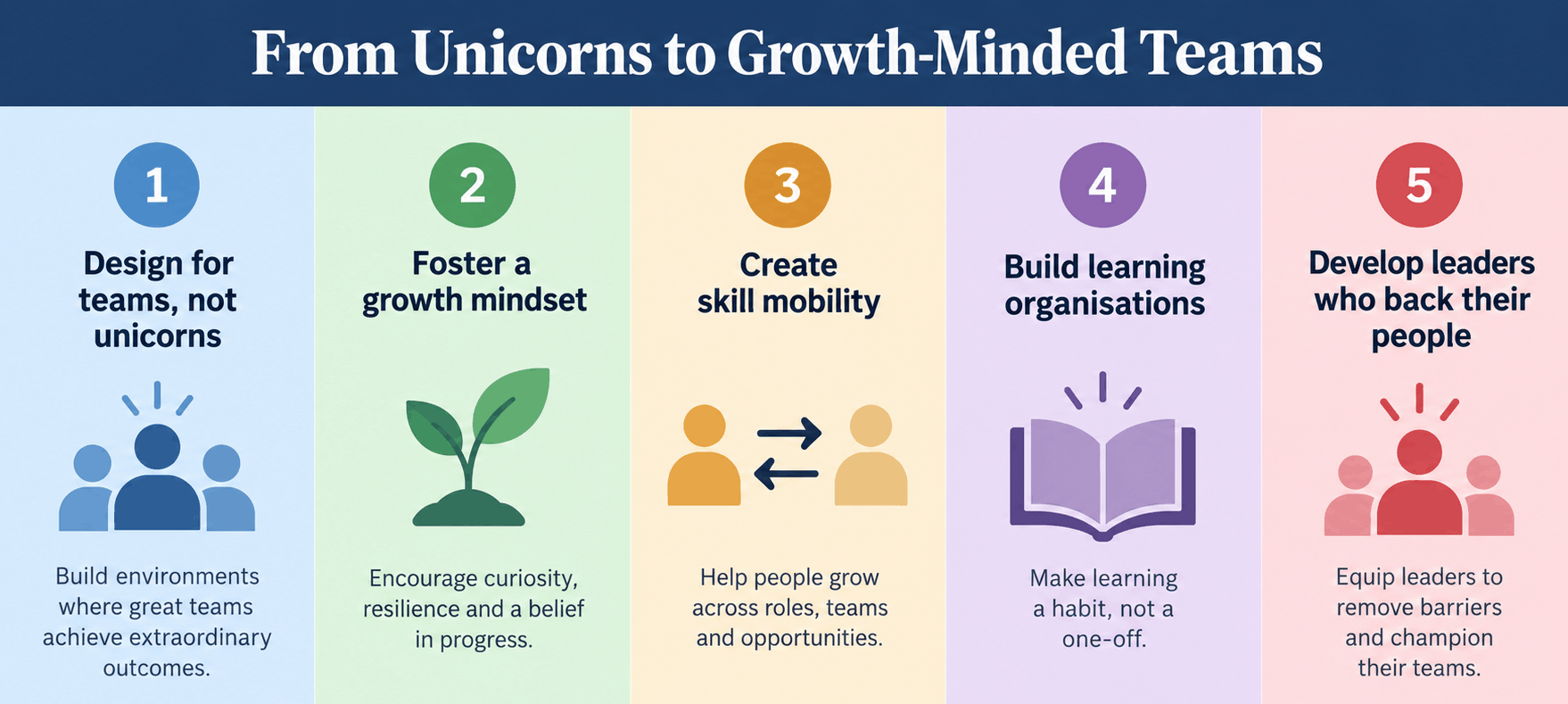
Building grow-minded teams
Five areas can make the difference:
1. Design for teams, not unicorns
Before writing a job description, look at what the team actually needs:
Which skills require deep expertise
Which can be developed
Where existing team members or specialists can fill the gap
The goal is collective capability, not individual perfection.
2. Foster a growth mindset
Don’t try to tick every single box. Look beyond this to find candidates with curiosity, adaptability and willingness to learn. However, ensure the right support is in place to build for upskilling or cross-skilling.
3. Create skill mobility
Cross-functional work, mentoring, communities of practice and internal mobility help people broaden their experience but this needs clear structure; so flexibility creates growth rather than confusion about accountability.
4. Build learning organisations
Make it normal to ask questions, seek feedback and acknowledge gaps. Give people time to develop and encourage collaboration across disciplines.
5. Develop leaders who back their people
Leaders should understand their team's capabilities, recognise unrealistic expectations, coach, remove obstacles, and know that sometimes the best decision is offering support rather than asking someone to stretch further.
What This Means for the Future of Agile Coaching
Agile Coaches may not always carry that title in future, but their skills such as facilitation, systems thinking, emotional intelligence, coaching for performance, are more essential than ever, across a wide range of roles and business environments.
The challenge for organisations is building career pathways and team structures that support this. Not everyone needs to become a leader, a coach, or an AI specialist. But everyone should have the opportunity to develop relevant skills, contribute their strengths, and grow in ways that create value for themselves and their organisation.
Closing Thought
The smartest people are often those who know what they don't know. Business agility isn't about having all the answers, it's about creating the right environment to ask better questions.
Let's stop chasing unicorns and start building adaptable, empowered teams.